
How to build realistic rivers and water features

Water is one of the most powerful elements in any landscape. Whether it’s a winding river cutting through a valley, a quiet lake reflecting the surrounding scenery, or a small stream flowing beneath a railway bridge, water features add movement, depth, and realism to a model railroad layout.
Some of the most memorable layouts use rivers and waterways to connect different scenes, guide the viewer’s eye, and create natural focal points. The good news is that realistic water effects are often easier to achieve than many hobbyists expect. With careful planning and attention to detail, even a small water feature can dramatically enhance the overall appearance of a miniature railway.
- Think about how water shapes the landscape
Before creating a river or lake, it’s worth considering how water behaves in the real world. Water rarely exists in isolation. Rivers carve valleys, streams follow natural slopes, and lakes settle into lower areas of the landscape. Designing terrain and waterways together creates a much more convincing result than simply adding water after the scenery is complete.
Looking at photographs of real rivers, lakes, and coastal areas can provide valuable inspiration. Notice how shorelines curve naturally, how vegetation changes near the water, and how bridges and railways interact with the surrounding environment.
- Start with the Riverbed
A realistic river begins long before any water material is poured. The shape of the riverbed plays a major role in determining how convincing the finished scene will look. Gentle curves often appear more natural than perfectly straight channels, while varying widths and depths help create the impression of a real watercourse.
Adding subtle banks, rocky edges, and shallow areas can make the river feel like it has evolved naturally within the landscape over many years. The goal is to create a believable foundation that supports everything added later.
- Use color to create depth
One of the most common misconceptions about model water is that realism comes entirely from the clear surface layer. In reality, much of the visual effect comes from the colors beneath the water. Darker tones in deeper areas and lighter shades near the shoreline help create the illusion of depth. Browns, greens, and subtle blue-gray tones often work well depending on the type of water being modeled.
Even before the final water surface is applied, careful painting can dramatically improve the realism of the finished scene.
- Add natural details along the shore
The areas surrounding the water are often just as important as the water itself. Grass, rocks, driftwood, bushes, and small patches of vegetation help blend the river into the surrounding scenery. Without these transitional elements, water features can sometimes appear disconnected from the rest of the layout. Small imperfections are especially important. Nature rarely creates perfectly clean edges, and a slightly irregular shoreline often looks much more realistic than a perfectly smooth one.
- Bridges create natural focal points
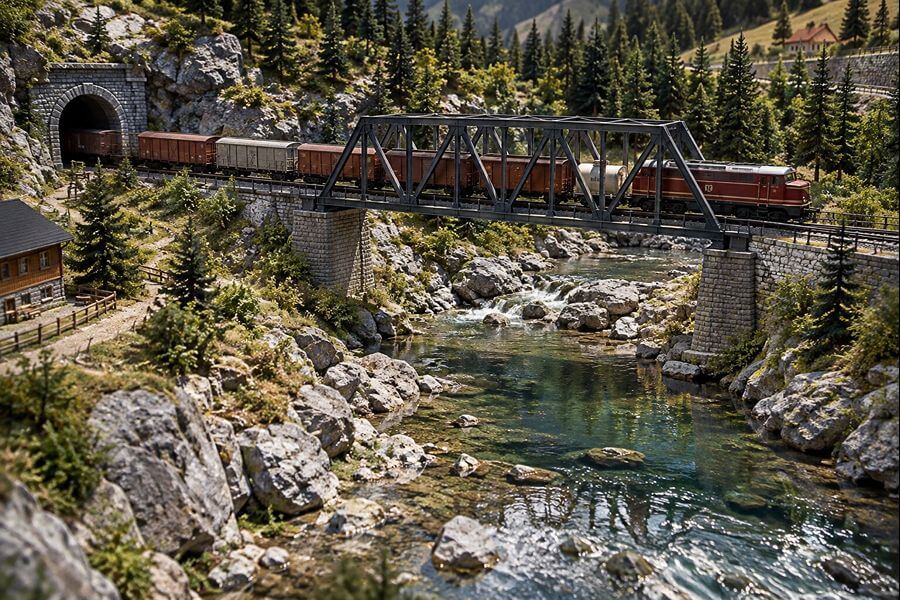
Railroads and water often intersect, making bridges some of the most visually striking features on a layout.A steel truss bridge crossing a river, a stone arch spanning a small stream, or a timber trestle over a mountain creek instantly adds character and creates a scene that naturally attracts attention.
Bridges also provide opportunities to combine multiple scenic elements within a single area, including water, terrain, vegetation, and railway infrastructure. When designed thoughtfully, these scenes often become the highlights of an entire layout.
- Don’t forget reflections and movement
Real water is rarely completely still.Even a calm lake contains subtle variations in texture, while rivers and streams constantly reflect light and movement. Adding gentle surface variation helps avoid the unrealistic appearance of perfectly flat water.
The amount of movement should match the type of water being modeled. A mountain stream may feature visible currents and small rapids, while a quiet pond should appear much calmer. These subtle differences contribute significantly to the realism of the scene.
- Tell a story through the landscape
Like every part of a model railroad, water features become more engaging when they contribute to a larger story. Perhaps fishermen are standing along the riverbank. A small boat may be tied to a wooden dock. Wildlife might gather near the shoreline, while maintenance workers inspect a bridge overhead.
These details encourage viewers to spend more time exploring the scene and help transform a simple water feature into a living environment. The most successful layouts often combine technical skill with storytelling.
- Less can be more
A large river isn’t always necessary.Sometimes a narrow creek flowing beneath a bridge or a small pond near a rural station can have just as much visual impact as a major waterway. Carefully placed water features often feel more realistic because they complement the layout rather than dominate it.The goal is to create balance and support the overall story of the railway.
Realistic rivers, lakes, and water features add a unique sense of life to a model railroad. They create natural transitions within the landscape, introduce visual variety, and provide opportunities for memorable scenic compositions.
By thinking about how water interacts with terrain, vegetation, and railway infrastructure, you can create scenes that feel authentic and immersive from every angle. Whether you’re modeling a mountain stream, a winding river, or a peaceful lakeside setting, thoughtful design and attention to detail will always produce the most convincing results.
- Bringing landscapes to life
At Lokomote, we believe that great scenery is what transforms a model railroad into a miniature world. From realistic rivers and bridges to handcrafted terrain and custom-built landscapes, every detail contributes to a scene that feels natural, balanced, and full of character.
Explore our latest projects and discover how thoughtful design can bring extraordinary realism to every layout.